Selected writings
Texts
Critical essays on CHUNG Hyun’s sculpture and drawing.
Life-ness Contained in the Uselessness and the Abandoned Youn Bum-mo · Art critic
Encounter with several scenes or things abandoned In October 2006, Venue the planning room in the National Modern Art Museum. There stood railroad ties that had endured a number of trains for a long time. Those had been lying in the wide empty plane and ran suddenly to stand in this place as if they had received some sort of oracle. Their outcry filled in the valley of Gwacheon Mountain. To the railroad ties that had finished their assigned task and finished its life, Chung Hyun, 'the artist of the year' selected by the National Modern Art Museum, gave another life.
The hero trimmed the tiles in the length of 3 meters and arranged them in a row. Those 40 structures were overwhelming the wide space in the way it made a breakaway with the commonsense of the art philosophy. It is because he made an epochmaking move in the art circle which member normally thinks of formative art as made of noble materials like granite and bronze. Wooden tiles were in short some sort of foundation thing that dedicated itself under the racing trains, the things that showed the true meaning of sacrifice to the benefit of the others, and the things that would be trashed after serving its purpose with such an indifference by the human society in the same way that it had always been even during their service.
Now that the era has changed the railroad ties have even degenerated into some sort of wastes. One person cast a warming gaze upon those wastes, and that was Chung Hyun who was selected as the artist of the year. This fact was further confirmed by the reminiscent exhibition held in the Art Museum. The title of the railroad ties were Untitled but it surely reminded of the lower body part of human. Being inserted with some sort of interposition, the two pillars were nothing short of the human lower limbs.
These lower limbs were omitted with the trunk of the body which was important, especially abandoning the head part. The long painful lifetime and the scars embraced by the material made the tree nothing better than the forsaken that is far from elegance. The rough and shabby piece of wood evinced the long and painful life with the dark skin and scars engraved upon it. Such railroad ties, which had been lying on the field for its entire life, were now forming a herd to be arrayed in the same direction.
Without the upper body, or rather having abandoned it, they were producing some sort of symbolization. These construction was reflecting the human society that is ever increasingly int the process of being materialized. It reminded of the spiritual world which had been long expelled, and the remaining physical world that is overwriting the reality. Furthermore it was so majestic to the extent that it exerted high-handedness to those before it.
What does the array of the bulky lower body mean without its lower part? In June 2004, Venue Kim Chong-yung Art Museum. The concrete asphalt(ascon) that had once paved the road was occupying the display floor of the museum after being abandoned. Jung was the person who dragged the discarded pavement materials all the way to the Art Museum. He held the private exhibition to celebrate him being selected as the 'face of the artist' by Kim Chong Yung Museum.
In this exhibition, he also turned back on those elegant materials in favor of the wastes. Ascon refers to the dark wastes left over after refining the crude oil. This is usually the favorite material for making roads, so it had some part in blackening a number of cities so far. But when the roads are dug up again for revampment or reconstruction, they are mostly ill-treated as some sort of trouble to dispose. The artist collected the trashed wastes and breathe in new lives to them.
He trimmed and cut the black lump to the reasonable degree and dispersed them here and there on the floor. These looked like a group of islands in the Dado Sea but of course in the posture of a human body lying down. It was the resurrection of the wastes settling in the sandy field. Not only that, it also refreshed some strong liveliness there. The stone yard of Ryoan-ji temple in Kyoto which is best renowned for its artificial beauty is an artificial garden in which small and big 15 stones are arranged appropriately on the line made by raking the sandy field.
Some praise it highly as the formative revelation of the calm and focused mind which is the famous symbol of Japan. Other say their arrangement is in the shape of the Chinese character heart. And one study saw its arrangement as representing the Cassiopeia constellation, for which it even tried to elevate it to the status of the universe garden. People of the next generation were trying to attach excessive meaning to the arrangement of the stones and stands.
How could one encapsulate the beauty of Japan in such a compact expression! Should I like that sort of beauty or not, I did not know the answer. The stones gathered on the sands. One was pretending so noble that it tried to give up on the smell of human sweats with such a constant pedantic approach. The human figure which was made of discarded ascon on the sand made one ruminate over the existence of human or the true nature of objects.
The virtue innately contained in that very essence was the smell of humans. Among those, how could he give back lives to those abandoned after losing their uses, those disfigured and forsaken, and the ugly ones of no use! Chung, Hyun's artwork was directly connected to the return of a human form, that is, the return of a living thing. Giving Life to the trivial. At college, Chung, Hyun was baptized with the modernism detached from the reality.
His scepticism during the school life led him to wandering. But that doesn't mean he was directly led to the pro-democracy student movement. He rather chose to go to France, which was reputed as the mecca of 'elegant art', in order to construct the art world of his own there. But the exhibition to celebrate his return to the home country caused a wide curiosity by filling itself with the artworks that were not expected by many people.
Though decided on humans as the exhibition title, there was no beauty of human body displayed in the place. There was no sculpture of well-proportioned lady with a beautiful face, nor any elegant body shapes that made use of qualitative stones like done by many Italia background artists. Apart from simply disregarding the forms, the materials that he chose were 'market-valueless' humans that were made of Manila flax plant and plasters.
Such start made one anticipate that his artistic activities would be a breakthrough with the previous artists of the French background. The title was human, which is all-time no. 1 subject of investigation for the old and the young all alike. Along with it, other materials that were chosen were not expensive luxurious materials, but old-fashioned wastes. That is why most of the materials composing his artworks were trivial stuffs like railroad ties, ascon, coal and rough stones.
Chung, Hyun would rather choose the rough stones that can be found everywhere rather than granites and marble stones which are classy and elegant. Those rough stones could even be used for the real construction works. They are not only shapeless but also have no consistent texture, which means it would be hard to handle them for a creative work. But the artist gradually discovers a contingency through the irregular nature of the stones and starts to understand the formativeness during the working process.
Rather than insisting on his own willness from the outset of the work, he would find a tangent point in which a mutual agreement would be reached. It is the same for the lump of coals that he purchased himself from the mine. Spending time with the stones that look willy-nilly let the artist arrive at some sort of conclusion with the forms to give. The artist exchanges emotions with the useless materials that attract no other artist, and searches for the road to the
[…]
Dramatically Emotional Sculpture for the Valuable Essence of Non-subjects Chae Eun-young · Curator
Incheon locals can frequently spot giant containers or trucks loaded with industrial materials while driving or taking a walk since Incheon is a trade port with an airport and railroads. When a truck passes, the ground quietly sinks, albeit to a microscopic degree, and non-subjects including the sounds coming from the truck-machines, dust, the smell of diesel, and the forms, smells and creaking noises of the loaded materials (raw lumber, scrap metal, and export-bound cars) are quickly perceived in one lump.
One usually looks past them as brief surprises or fear of having had their safety threatened, but if they ponder it again they will be stunned by how even sentiments connected to the sensations of different parts of the body are vividly revealed. The artist Chung Hyun's discarded crosstie work includes whole sensibilities and sentiments from such memories of what he ordinarily felt by the railroad as a child. The artist, who discovered the depth of experience and sentiments in the traces of the scrapped crossties that have gone through a process of severe hardships, creates art revealing and elevating the value of lowly and invisible, trivial things.
Viewers imagine and think about life's process within past time held by entities with exhausted economic use value, as well as the strange, dark and lonely emotions given by dry and rough visual forms they face first. The space and time of the moment one meets the non-subjects that have the depth of experience require the dimension in which time and space complexly cross the time of several subjects and non-subjects, and not the everyday dimension of meeting art for cultural enjoyment and as a hobby.
The artist discovered the essence in removed crossties he saw in his youth, and he discovered depth in auditory organs that were dark and dim due to old age. He began to form an awareness of the individual and society through Eunyul mask dances he saw in college, and he realized the valuable meaning in-season freshness provides through fish including large-eyed herrings and gobies. While these four things are related to the place of the area the artist grew up in, the artist does not represent local subject matter and historicism through the idea of the hometown or criticize the local area's absence and deficiencies through the idea of a world of demons.
Instead, he focused more on contemplating the quintessences of humanity as a subject in the world and life and on organizing his life as an artist. When thinking of the Otherness of junked crossties, auditory organs, the Eunyul mask dance, and fish; one can peer into a relationship capable of leaving behind human vs. non-human, place vs. non-place, subject vs. non-subject, nature vs. culture, and object vs. organism human-centered dualist worldviews.
The artist having focused on humanity's essence and depth is for a praxis for a world based on understandings and interpretations between entities that existed in unstratified and relational attitudes but were invisible, rather than being the essence of human beings as subjects in a world centered on people and capital. It is work including the time and space for a place accompanying the moments and processes in which non-subjects hidden by people and capital, such as objects, space, culture, and organisms, reveal their valuable essences.
Art's role and significance as a medium of bright and good appreciation and experiences are being increasingly emphasized in arts and culture education and life culture. In such a situation, the role of art pursuing an essence is heavy, dark, difficult and foreign. Nonetheless, the meaning of art with slow time and spaces of different directions is not light. The artist's installation work represents dramatically emotional sculpture of old and deep non-subjects.
One can intuitively feel the inherent sensibilities revealed by the objects without explanations of their localness or historicity, and they can know it through the objects' practical expressions. Also, it is actual as an expression of time holding time. It is an ontological revolution in transition from a space-centered perspective emphasizing localness and the place to the other axis of temporality. People form deep relationships to the place-qualities of the spaces they grow up and live in as they form their individual worldviews and sensibilities.
However, it is not easy to sensitively and delicately reorganize an area's place-qualities as an artist. When we use the words local art or local artist, we limit their meaning to areas as physical spaces and place-qualities and historicity as the subject matter or subjects of art and activities. I discover a locality as a different localness pursuing the valuable essence through a complex and delicate temporality non-subjects hold and recomposing it with reflection on the human and capital centered world, from an unstratified and relational, diverse cultural anthropological perspective; rather than forming close relationships with any human-centered localness, place-qualities or historicity; in the artist Chung Hyun's work. eunyoung chae studied statistics, arts management, and art theory.
She is a research-based curator with a strong interest in the imagination and praxis of visual art that has a healthy tension relationship with capital and the institution in the urban space. She has been running space imsi, which is involved with visual art, the idea of localities, and ecological politics, since 2016. "
Artist of the Year 2006 — Foreword Kim Yoon-soo · Director, National Museum of Modern and Contemporary Art, Korea
The exhibition, "Artist of the Year" at National Museum of Contemporary Art Korea has been annually organized by selecting an artist who has shown the most outstanding activity in the Korean art world. This year, the sculptor, Chung Hyun has been selected for the exhibition. In the world of contemporary art where new genres and new media constantly come into fashion, Chung Hyun is searching for significance and esthetic sense of his works through the traditional subject of human body.
Although rough and crude as if unfinished, his works contain serious reflections on life and human. The artist's interpretation of sculpture is "power" and "energy". In other words, they contain the image of human as an individual being, that is, as a being that recognizes its own essence. While expressing power through human forms, the artist discovers the forces of' freshness detected in the trivial, liveliness of the raw, unpredictable images, abruptness and primitive violence, etc.
'from material properties of fragments and fortuity in the courses of creation. He brings life to the materials far distant from being the traditional materials of sculpture, such as railroad ties for railways, asphalt concrete, rough stones and coal, etc., which can be regarded as the remnants of civilization. The exhibition offers us a glimpse of Chung's art world from past to present. It features 60 sculptures and 60 drawings from five different time periods, showing us the changes in form and material.
I believe this exhibition will provide the public the precious opportunities of experiencing the inner world of this sincerely trying sculptor who have been continuously substantiating his existence through artworks. With sincere gratitude to the artist who have unsparingly dedicated effort for this exhibition, I would like to thank collectors who have offered the precious art pieces for the exhibition and also to thank staffs for their hardworking. Artist of the Year 2006 : Chung Hyun Assistant Curator, National Museum of Contemporary Art, Korea Park Soo-jin Sculptor Chung Hyun has been selected as 'artist of the year 2006.'
Established in 1995, the 'Artist of the Year' award is given annually to the artist who has shown the most outstanding activity in representing the Korean art world. Selected by curators of the National Museum of Contemporary Art, Korea, the artist is given the opportunity to hold a solo exhibition at the Museum the following year and Chung Hyun is the first to be given the award in the field of sculpture. In his work, Chung Hyun has mainly focused on the human body.
Although most contemporary artists have experimented by making various attempts to express facial features, Chung has constantly explored the significance of art form through the human body. His works seem unfinished, therefore appearing rough and crude. However, internally, his works contain genuine anguish for life and human beings and displays humans as individual entities standing on their own. The artist's interpretation of sculpture is "power" and "energy."
The artist, while expressing power through the dynamism of the human body, discovers power from fortuity of the courses of creation and physical substantiality of the pieces, such as freshness discovered in the trivial, power of life exuded from the raw, unpredictable images, abruptness and primitive violence, etc.. For him, the trivial are remnants of civilization, such as railroad tie, asphalt concrete and stones, which are distant from the traditional materials of sculpture.
The artist mentions the importance of material in his work by saying that he 'plays with the materials, rather than fighting against them 'in order to bring out the properties of the materials as much as possible. The exhibition offers us a glimpse of Chung's art world from past to present. It features 60 sculptures and 60 drawings from four different time periods, showing us the changes in form and material. His first piece was created between 1985 and the early 1990s, which was the period of his studies in France.
He is expressing the dynamic human body with several compressed lines that do not display volume, such as bone structures and muscles, etc. by distorting the actual figures. The tension in this piece is accentuated by manila hemp in plaster and tautly stretching it over the surface. The second was created in the years of 1995~1999. This bronze head and torso without eyes, nose and mouth is contorted and shows many vague traces to express the pain of human existence.
The third was created in the last 1990s to the early 2000s. In this piece, where he worked with railroad tie, the human body is almost completely dismantled to border on abstract. The wood torn into pieces and railroad tie cut with ax and attached in entanglement represent human as a being that has been predestined to endure stoic life. This phase of his work is significant not only in terms of the size of his works, but also the introduction of new materials.
The fourth work was created in 2004~2005 by using asphalt concrete, unprocessed stones and coal lumps. The works made of asphalt concrete are human figures created by combining masses violently cut up into pieces with an electric saw. They strongly illustrate only the physical substantiality of the material used. Also from unprocessed stones and coal lumps, the artist produced abstract figures. Through his art world, Chung Hyun, who adds contemporary interpretation into traditional sculpture and brings abandoned materials into the world of art, let us look back at the aesthetics of 'novelty' which is spreading out as a craze in present times. Interview with Chung Hyun Professor, Korean National University of Arts Yang Jeong-mu Q.
I think your works have focused on a body by now. Do you regard yourself as a 'body sculptor?' A. I have never given a priority to a body itself in my work. A body is just an object to me. I would say that a body has been a good object to express a life, and that's the reason I choose it. Q. Your works seem to be away from a direct expression or an aesthetic production of a body. However, frankly speaking, I would like to point out your attitude to stick to a traditional theme, a body, compared to other sculptors of the same age who have attempted bold experiments.
A. A sculpture of a human body is very familiar to people. So, they may not be able to find freshness from it. However, I do not concentrate on freshness at the beginning. I just enjoy finding out a variety of life of human beings little by little as opening my eyes to the world gradually. Q. I am a little bit doubt about that you do not care about freshness as a contemporary artist. A. Devoting for freshness is a kind of the features of contemporary arts.
However, freshness exists not only in a new thing but an old one. In my case, freshness would be found in my trial to change relationships between me and objects. Q. I think your works in the day you studied abroad focused on lines. But, your first private exhibition seems to be disconnected from the feature. A. Themes of both works are based on power. The subject is still alive in my works. It is sometimes presented as lines and sometimes as a vague, lump form without specific expression.
The works created when I studied abroad are born through a process to break the Realism. I wanted to get into the point without superfluity. That is represented with lines. Each line means a realistic existence of spirits torn apart. Even at that time, there were some works with volume. I made a specific form into a lump by hitting or driving with a lump of steel or a wooden bat. In the end, emotions were concentrated and then the volume became distinctive.
I think such massive works appeared in my first private exhibition in 1992. Q. You have mentioned the
[…]
From Sculpturing to Auto-Sculpturing Yoo Heon-sik · Philosopher
The materials Chung Hyun has been showing attention to in the few recent years are mostly 'nothing much'. They are railroad ties expired of use and coal waiting to be given a purpose. Why the interest in nothing much? They have already been or are being used, therefore are not sophisticated. They are simple and crude. In fact, what is truthful is simple and crude. Something that has just been made cannot penetrate into the center.
So, the materials he uses are those thrown out from the center or yet to reach the center. Here, the 'center' is practical value. Chung Hyun intends to create aesthetic value from the materials rejected of their practicality. It is because these materials are built in with possibilities given as existing beings prior to and after their practical values. By granting the right to claim one's existence as' already something' and 'yet to be anything', the artist intends to secure aesthetic life that is differentiated from practicality.
Materials are no longer mere objects to him. To materials, he grants the position of subjective being. At the same time, he clearly executes them with substantial causes by escaping from formative causes. The materials, at last, meet up with Chung Hyun, the person who will realize their beings as they truly are. Through his hands, they slowly reveal their bodies and faces. What is standing with open arms or standing on hands is not a human but a railroad tie.
What is lying down is not a human but asphalt. The dark object engulfed in silence is not the face of a human but the face of coal. Although the artist himself is the titular owner of the works, the actual master of them is the materials used. To the materials, which do not have the power to awaken themselves, the artist lends his hands and strength so that they can be reborn. A path not to be found within materials is never to be found outside, either.
Only the artist's narration breathes life into the materials and creates a piece of work with meaningfulness. For the artist, materials are the means. For materials themselves, they are the objective. The objective is realized by borrowing the aesthetic sensitivity of the artist. So, emphasis is placed not only on the external aspect displayed in the series of works using railroad ties, asphalt concrete, coal and iron plates, but also on the internal aspect to bring out the story embedded in each material.
I define such characteristics of Chung's works as 'naturalistic narrativeness'. I hope the entire world can sympathize with the uniquely Korean naturalistic narrativeness embedded in the spirit and works of Chung Hyun. However, my concern is on the 'contents' of the naturalistic narrativeness. In order for Chung to confidently introduce himself as a 'sculptor of Korea', I would like to see the elements of 'Korean cheerfulness and gaiety' added in the contents of his works.
The narratives of his works are, on the whole, gloomy and dismal. Korea is not just a sad and serious country. The humor and satires contained in folk tales and legendary narratives deliver stories of a bright and pleasant world. Just because the materials are heavy does not mean that the contents need to become heavy and serious as well. I look forward to finding a message of hope emerging from a corner of his works.
Reality of Things and Reality of Being Choi Tae-man · Professor, Kookmin University
The sculpture of Chung Hyun starts from interest in the configuration of a human. From ancient times, the human body has been an important subject matter. In particular, in classical art, the configuration of a human was often treated as a subject implying ideal beauty and was recognizable 'tabloid edition of the universe.' However, the human body expressed by Chung Hyun is starkly different from such traditional sculptures.
The form of his work is rugged, the methods employed intense and sometimes even violent. This 'untamed intensity' is an important factor which adds to the reality not only of the materials but also the existence of humankind. Firstly, the reality of materials is the characteristics discovered in his works where physical attributes of materials, such as plaster, railroad ties and asphalt concrete, are wholly exposed. Plaster works are created by hitting and digging a mass of earth with high plasticity by using the tools such as bars and shovels.
These works hold solid shapes because of such violent processes. Although the form certainly is of a human body or face, it is difficult to find specific shapes from it. By going against the traditional method of delicately depicting and reproducing external forms of the body by using the traditional shoehorn, the artist is escaping from the solidified tradition of reproduction, in other words, the academism. The sculptures of human figures created by using railroad ties, which had been thrown away after long years of supporting heavy trains, or asphalt concrete, the symbol of modern city, are also violent, rough and expressionistic.
The works to display surface textures created by sawing and cutting railroad ties or asphalt concrete with powerful tools of electric saws or grinders are presented with the physical reality of materials extremely accentuated. Through these works, we can experience not only the minimum of human forms, but also the reality of materials themselves. What we must take note of here is the fact that the artist's thought for sculpture, his action to put it into practice and the form as the result of such action are untied together to form a harmonious whole.
The fierceness in his working processes similar to almost violent maltreatment of the materials, however, represents the suggestive characteristic to unite with the materials in certain aspects, rather than aggressive attack towards achieving 'victory' to remove the physical characteristics of the materials. Chung expresses this course of labor as 'playing with materials'. Maybe, it is a type or extension of possession by spirit where the artist's emotions, thoughts and ideologies unite with the vivid properties of materials.
Therefore, the forms created by the artist may well be the totem of an age where god existed. However maltreating he may be to the materials, the artist does not throw away the materials which had been thrown away before. Railroad ties and asphalt concrete stand in their positions as the main elements of his works without their own properties and characteristics destroyed. 'Playing with materials' does not mean he rules over the materials.
It represents the artist's intention to become untied with them. The human forms created by the artist do not let or instruct us to remember specific targets. However, as the emotional sensation stirred up by railroad ties or asphalt concrete is of the accumulated time, the time of endurance over difficulties and the time of silence spent with perseverance to fulfill the individual purposes, etc., we must remember that his human forms represent the reality of being because they let us think about the universal values of human who, although worn out through 'maturation of time', still maintains dignity.
Today’s Artist — CHUNG Hyun Choi Jong Tae · Director, Kim Chong Yung Sculpture Museum
The exhibition series, Today s Artist , has been established by the Kim Chong Yung Sculpture Museum to discover and encourage young, talented artists keeping in accordance with the spirit of Kim Chong Yung who was constant in his work as an artist and educator. Every year, our museum selects at least 2 artists who display singularity of vision and commitment to their art as Today s Artists , and invites them for a solo show at the museum.
In doing so, along with the The Woo Sung Kim Chong Yung Sculpture Prize that the Kim Chong Yung Memorial Enterprise has been carrying out since 1990, we hope to provide the pivotal point in the advancement of Korean sculpture. Today s Artist is an artist who shows great promise in the medium of sculpture with a distinguished body of work, and is carefully selected based on standards that are independent and unique to the Kim Chong Yung Sculpture Museum.
Its purpose is to inspire young artists and provide a forum for presentation of their work, carrying out the wishes of Kim Chong Yung who was exceptionally devoted to the training of students. The sculptor Chung Hyun who is our first Today s Artist this year has already received critical attention for his depiction of the tough and strong human figure using railroad ties. The railroad tie may not seem like an appropriate material for sculpture, however Chung Hyun makes cuts, and clear and sharp incisions on the surface with a power saw to render the basic shape of the human body, thereby changing the tradition of figurative sculpture.
Chung Hyun s railroad tie sculpture commands attention not only for its use of unusual material but also for the symbolism carried by the material. For example, one cannot help but think about the silent endurance in human history when considering a material that has weathered the massive weight of the trains while absorbing the natural elements of rain, wind, dust, and oil stains. In this exhibition Chung Hyun deals with asphalt, yet another unfamiliar material for sculpture.
Known as petroleum-asphalt, this artificial byproduct of civilization is the black debris left after the petroleum has been filtered out at the oil field. Its adhesive strength is very high, but it is also very sensitive to temperature, and although it is being widely used for building and paving roads, it is hardly used as material for sculpture. Chung Hyun gathers clumps of asphalt dug up at road construction sites and cuts them up using a tool like a grinder or makes sharp incisions on the surface to create human figures that are lying down.
The human figure composed of several clumps of asphalt resembles a large stone face and stimulates our imagination as we look for the human figure in a natural setting. His work takes on a new appearance as one changes viewpoints. When viewed from above one finds a human figure lying down, but when viewed from below the work looks as if stone islands are grouped together in a wide open sea. His work has the forms of both nature and human figure and aims to achieve a living form created by raw material and solid mass, as evidenced by his work made of railroad ties.
Not only in sculpture but in drawings, Chung Hyun depicts the overflowing energy of the human spirit through lively and energetic lines and contrasting color tones. Chung Hyun s work is rough and simple on the surface, but it is also important to remember that one can also find the natural order of death and rebirth. Such quality is in perfect accordance with the aphorism by Kim Chong Yung, who emphasized that art creates infinite order within finite space.
This is the reason behind our museum s selection of Chung Hyun as an artist whose work succeed in realizing the ideals pursued by Kim Chong Yung. It is our sincerest hope that the Today s Artist exhibition presented by the Kim Chong Yung Sculpture Museum may reach its ambitious goals of playing a small role in the development of Korean sculpture. We look forward to and appreciate your encouragement and guidance. […]
CHUNG Hyun and the Affirmation of Sculpture Kim Wonbang · Art critic
The human figure in Chung Hyun s sculpture The sculpture by Chung Hyun has been generally categorized as sculpture of the human figure . This is not entirely wrong. Based on the body of work ranging from his first solo exhibition in 1992, objects constructed with railroad ties around 2000, the work using asphalt-concrete prepared for this exhibition at the Kim Chong Yung Sculpture Museum, and drawings, it is clear that the form of the human body is a recognizable characteristic of his art.
The artist himself does not deny that his work began from the study of the human figure and continues to deal with the problem of the sculptural depiction of the human figure. For example, he has said, By means of sculpture I attempt to reexamine and reinterpret humans and the human figure ( ) There still remains a lot to do with the human figure. It is not a thing of the past. His work has also been widely viewed as man s existential state in the face of crisis and despair or a portrait of ourselves today with a layer of appearance stripped away .
Sometimes a term like stoicism is suggested to describe his work. The work constructed with the railroad ties in particular is discussed in relation to a kind of long period of stoicism . Chung Hyun himself has said, The railroad tie is a work of art on its own in that it has endured for many years snowstorms and rainstorms, while the train weighs down from above and below the pebbles dig into the wood. While it is true that Chung Hyun s sculpture is related to the human figure and human existence, it nonetheless requires supplementary explanations about the work.
The first thing we need to pay attention to in Chung Hyun s work is that the human figure and human existence, in other words, the anthropomorphic and the figurative aspect of the work is not the ultimate goal of the work. In his work, the form of the human figure only has vague, subtle presence, and as evidenced by the plaster-cast work formed by clay being modeled with a shovel, the railroad tie objects carved with an axe and a power saw, and the asphalt-concrete sculpture in this exhibition, the human figure is almost buried in the intensive sculptural act with the material in many cases.
Thus the form of the human figure and the anthropomorphic element only make up a partial aspect of Chung Hyun s sculpture and a critical description of this partial aspect seems to be the starting point of study of special qualities of Chung Hyun s work. By asking questions like To what degree is Chung Hyun s sculpture about the human figure? , How does the human figure manifest itself? , and most of all, What else is the work about, if not the human figure? , we can discern and analyze his work within the dynamic shifts of the structuralized boundaries between the human figure/non-human figure , or presence of sculpture/absence of sculpture .
During his study abroad in France, Chung Hyun abandoned the kind of realistic sculpture he had done in Korea and began rough modeling with the clay using tools like a square bar, a lump of metal, and a shovel. The artist considers this period a turning point leaving behind academic sculpture. He begins to think of the human figure as simply the object and at the same time, his sculpture turns away from the teleological concerns of representation of the human figure and begins to take on various forms of play taking place within the limited condition set forth by the human body .
When he says that the human figure is simply the object , it means that the form of the human figure is not the final aim but it doesn t necessarily mean that his work is completely turning away from it. In Chung Hyun s previous work as well as the new work made with asphalt-concrete clumps pulled apart with a power saw, contours of the human figure like a corpse are present, however vague they may be. This presence of the human figure can amount to no more than just an arrangement of heaps of stone and represents a figurative sculpture that has taken a step back .
This sculptural retreat however brings out new aspects, key elements that were previously left out by the epistemological and intelligible reading of his work focusing on the human figure and its anthropomorphic aspect. What stands out can be described as a furiously entangled dance; a dance between the power that is applied to the material and the material that resists that power. The condensed heap of rubbles penetrated and sliced and sections of asphalt and rubbles that have been cut, such are the manifestations of the dance.
But if we are to say Chung Hyun s work is all about the aesthetics of the material or the expression of the material then it would be no different from the aesthetics of the Informel or Abstract Sculpture. The unique qualities of Chung Hyun lie here that there is a kind of stage providing simultaneously the place as well as limitations for this dance with the material. That stage is in fact the form of the human figure and the dance with the material only takes place on this stage.
In doing so his work is able to retain both materiality and formality, and body and spirit, instead of being reduced to either one of the two extremes. I would like to use the term Whole Sculpture to designate this characteristic of having both elements together. Furthermore we can conceptualize such ontological position as the sculptural . Cybernetics of Whole Sculpture From the human figure to the body The aim of the intense dance with material is not to copy the human figure.
The form of the human figure is merely the temporary stage set up by Chung Hyun, the dancer. As the dancer s job does not lie in copying the form of the stage, the stage only becomes aware of its boundaries intermittently or accidentally from time to time in the midst of the dancer s erotic exercise. The totality of the whole sculpture (unrelated to the concept of Gesamtkunstwerk) is the result of conserving altogether the dance and its stage, the aesthetics of the sculptural ingredients and the form that these ingredients represent.
Chung Hyun s sculptural form does remind us of the intense process of the existential endurance, but we should go one step further to really focus on the intensity and endurance of the dance which sustains the whole preservation. That is in fact the intensity and endurance of the sculpture itself. Within the site of the Whole Sculpture , there are two pathways leading to the human figure. One is the reproduced human form , in other words the human figure , and the other is the dancer who dances with such human figure and its materials (in other words, the main body in the relationship between the artist and audience).
Whereas the former is merely an object of visual perception, the latter exists only in the first person I , in the here and now . The latter is I as a firsthand participant who is sensually immersed in the sharp refractions of the asphalt clump that is before me at this very moment . When he started working with the railroad ties, Chung Hyun used to ask himself if he could ever win his struggle with the material. In line with this, sculptors often use the expression, the material is defiant .
Such expression has nothing to do the phallic culture that has to always change the natural state of matter into an artificial form. On the contrary, to say win over, or resist is the field terminology of sculptors as they try to express a kind of cybernetics , where physical senses are exchanged with the object, going beyond the cold visuality. Chung Hyun is an artist who indefatigably preserves and emphasizes the scene of that sculptural cybernetics.
The core of Chung Hyun s work is not the problem of the human figure, but that of the body, and although this body is not visible it signifies the entire field of my presence where intense mutual exchange between me and the object takes place. Chung Hyun s material struggles endlessly as if to copy somebody s face or pose
[…]
인간과 우리들의 힘 강수정 · 국립현대미술관 학예연구사
오늘도 전시장의 입구에 한 사람이 조각대 위에서 어깨를 깊숙이 머리를 파묻고 맨 등을 보이며 조각대에 올라 있다. 머리 위로 쏟아지는 조명은 선명하고, 등에는 삶의 파편처럼 빛과 뒤엉킨 그림자가 울퉁불퉁 새겨져 있다. 그의 등은 아우성도 없고, 변명도 없다. 모든 것이 명백하고 극적이며, 많은 것들이 실제보다 더 있어 보여야만 제대로 평가받는 이 시대에 도대체 이 맨 등 은 무엇을 의미하는 것일까? 이 무제 (도판1)는 조각 재료에 사람들의 모습을 담아 그 속에 온화한 생명력을 불어 넣는 작가 정현이 석고와 마닐라 삼을 이용하여 인체를 표현하고, 이를 통해 인간의 본성을 탐구한 작품이다.
그는 지금도 아스팔트 콘크리트, 철로용 침목 등 현대적인 재료로 사람들이 가지고 있는 개개인의 존재와 또 이들 사이의 존재감이 지닌 힘의 본질에 대해 지속적으로 관심을 가지고 표현하고 있다. 특히 석탄과 침목을 재료로 한 작품들은 그의 작품세계를 잘 나타내 준다. 무제 (도판2)의 석탄 덩어리는 작가의 손길이 스친 듯, 스치지 않은 듯, 덩어리 속에 갇힌 간결한 제 본래의 모습을 잘 보여주고 있는 작품이다. 이미지와 감정 과잉의 시대에 이 덩어리는 아무런 설명 없이도 마땅히 있음 으로 그 자리 를 지키고 있다. 이로서 우리는 석탄 덩어리의 존재감이 주는 묵직한 힘을 느끼게 된다.
또한 우리는 실제 철도에서 쓰여 진 15개의 침목을 주재료 한 무제 (도판3)에서도 같은 힘을 느낄 수 있다. 무겁고 낡은 침목들이 서로를 엮어 만들어 낸 둥근 공간을 점하며 묵묵히 서 있다. 이 침목들은 기차의 격렬한 속도와 무게를 돌멩이가 깔린 불편한 밑바닥에 누워 견뎌낸 것들이다. 이들은 아주 긴 시간 동안 무궁화에서 KTX로 변환되는 시간과 사람들의 이동을 지켜보며, 묵묵히 그 흐름을 자신의 몸속으로 받아 안고 존재한 것들이다. 이는 작가의 손을 통해 물질로 특성화되어 15개의 침목은 침목이되 침목이 아닌, 세상을 살아가는 사람들의 이야기로 거듭나게 되었다. 정현은 이처럼 과장된 표현보다는, 찍거나 파낸 행위 등을 통해 침목이 지닌 본성을 드러냄으로써 우리가 아무것도 아닌 것 이라 스쳐지나가는 것을 아무것이 되도록 하는 미덕을 선물해 준다.
이는 그가 이 물질들의 특성을 자연스럽게 드러나게 하기 위해 조각도가 언제, 어느 곳에서 멈춰야 할 때와 곳을 알고 있기 때문에 가능한 일일 것이다. 그리고 그것은 스스로를 비워내는 일이기도 할 것이다. 그러므로 침목은 작가 정현과도 매우 닮은 재료이다. 격렬한 열정보다는 온화한 눈빛으로 세상을 바라보는 그를 바라보면, 아마도 그만큼 곰 삭이는 아픔도 많았을 것이라는 생각이 든다. 그만이 가지고 있는 온화한 열정은 오늘도 물질을 가장 물질다움으로 구체화시켜 이것이 곧 사람들의 이야기로, 우리들의 힘으로 표출되기를 희망한다. 그는 우리에게 맨 등 을 보이고 있는 것이다. * 올해의 작가 2006 정현 전은 국립현대미술관에서 2006년 10월 13일 -12월 17일까지 개최됩니다.
도판목록 1. 무제 , 석고, 마닐라 삼, 38.5 26 32cm, 1990, 작가소장 2. 무제 , 돌, 27 17 205cm, 2005, 작가소장 3. 무제 , 침목, 250 160(지름)cm, 2002, 작가소장 4. 무제 , 종이에 콜타르, 55 39cm, 2002, 작가소장 5. 목전주 , 나무, 철, 1726 497 597cm, 2006, 작가소장 6. 정현 하찮은 것과 폐기물에 담긴 인체 혹은 생명성 - 정현론 윤범모(미술평론가) * 몇 가지의 풍경 혹은 버려진 것들과의 만남 2006년 10월, 장소 국립현대미술관 기획전시장 홀, 오랜 세월동안 숱한 기차들을 온몸으로 떠받들었던 침목(枕木)들이 서있다.
그들은 허허벌판에서 누워있다가 뭔가의 계시를 받았는지 미술관 안방으로 달려와 우뚝 서있는 것이다. 그들의 함성은 과천의 산골짜기를 가득 메웠다. 주어진 역할을 끝내고 일생을 마감한 이들 침목에게 다시 생명성을 부여한 이는 정현, 바로 국립현대미술관이 올해의 작가 로 선정한 주인공이다. 주인공은 침목을 높이 3미터 정도로 다듬어 도열시켜 놓았다. 이들 40개의 구조물은 드넓은 공간을 압도하면서 미술관의 상식을 깨트렸다. 조소작품하면 으레 청동이나 화강석 같은 고상한 재료로만 이루어지는 것으로 통용되는 미술판에서 하나의 파격을 이루었기 때문이다. 침목은 한마디로 선로의 토대로 질주하는 기차를 위해 헌신했던 것, 남을 위해 자신의 존재를 죽이면서 희생이라는 미담을 자아냈던 것, 사용될 때나 폐기될 때나 인간사회로부터 무심한 대우를 받는 하나의 나무덩어리에 불과했던 것이다.
이제 시대가 바뀌어 침목은 폐기물처럼 버려지는 존재로 추락하고 있다. 이 폐기물에 따뜻한 시선을 보낸 이가 있으니 바로 올해의 작가로 선정된 정현이다. 이같은 사실을 확인시켜 준 자리가 바로 미술관 회고전이었다. 침목의 작품 제목은 무제 , 하지만 그들 침목은 인간의 하체를 연상시킨다. 작은 삽입물을 끼고 있는 두 개의 기둥은 영락없는 인간의 하체이다. 이들 하체는 중요한 부분인 몸통을 생략했고 특히 머리부분을 방기했다. 재료가 안고 있는 인고(忍苦)의 세월과 숱한 상처는 우아함과 거리가 먼 버려진 나무에 불과했다. 거칠고 볼품없는 나무토막, 그것은 어두운 색깔과 함께 상처투성이로 고단했던 세월을 증거하고 있다.
그러한 침목이, 평생을 누워만 있던 나무들이, 이제 떼를 이루어 같은 방향으로 도열해 있는 것이다. 그들은 상체를 잃은, 아니 상체를 버린 체 무엇인가 상징성을 자아낸다. 이들 구조물은 물질화되는, 날로 육신화되는 인간사회를 반영한다. 영적(靈的) 세계는 방출당하고 육적(肉的) 세계만이 득세를 하는 세태를 연상한다. 그것도 너무 육중하여 때로 위압감을 자아낼 정도이다. 상체가 없는 이들 우람한 하체의 도열은 무엇을 의미하는가. 2004년 6월, 장소 김종영미술관, 포장도로를 덮고 있다 용도가 끝나 폐기된 아스팔트 콘크리트(아스콘)가 미술관의 전시장 바닥을 차지하고 있다. 도로포장의 폐기물을 미술관으로 끌고 온 사람은 바로 정현이다.
그는 김종영미술관이 선정한 오늘의 작가 로 주목을 받아 기념 개인전을 개최한 것. 이 전시에서도 작가는 고상한 작품 재료들을 외면하고 폐기물을 이끌고 온 것이다. 아스콘은 석유를 정제하고 남은 검은 찌꺼기를 일컫는다. 이는 도로포장용으로 즐겨 사용되어 도시를 온통 검은 색의 공간으로 만드는데 일조했다. 하지만 공사 등의 이유로 포장도로가 파헤쳐질 때, 아스콘은 폐기물이 되어 처치곤란의 푸대접을 받는다. 이들 버려지는 폐기물을 작가는 수습하여 다시 생명성을 부여했다. 검은 덩어리를 적당히 자르고 손질하여 바닥에 늘어트려 놓았다. 이는 다도해의 섬처럼 보이기도 하지만 물론 누워있는 인체의 모습이다.
모래 위에 자리 잡은 폐기물, 재탄생의 현장이다. 뿐만 아니라 거기서 강인한 생명력을 환기한다. 인공미(人工美)의 전형으로 자랑하는 교토(京都)의 용안사(龍安寺) 석정(石庭), 그것은 모래밭을 갈퀴질하여 남은 선 위에 크고 작은 열 다섯 개의 돌들을 적당히 배치한 인위적 정원이다. 일본미의 상징 혹은 선심(禪心)의 조형적 발현으로 상찬의 목소리가 크다. 돌의 배치가 마음 심(心)자와 같다더니 근래의 한 연구에 의하면 돌의 배치가 카시오피아 별자리와 같아 아예 우주의 정원이라고 격상시키려 한다. 모래와 돌의 배치, 이를 두고 후세 사람들은 의미부여를 엄청나게 하고 있다. 일본미를 그런 식으로 집약 표현할 수 있다니!
그런 미를 좋다고 해야 할까, 싫다고 해야 할까, 나는 할 말을 잃는다. 모래 위에 놓여있는 돌덩어리들, 한쪽은 너무 고상한 척 폼을 잡아 자꾸만 현학적으로 접근하여 인간의 땀 냄새를 포기하도록 유도한다. 모래 위에 놓여 있는 폐기물 아스콘으로 이루어진 모습은 인간의 존재 혹은 물질의 본성을 반추하게 한다. 그 같은 본질에 내포된 덕목은 바로 인간의 내음이다. 그 중에서도 용도 폐기되어 버려진 것들, 모양도 볼품없어 아무도 돌보지 않는 것들, 이렇듯 추하고 쓸모없는 것들에게 다시 생명성을 부여하다니! 정현의 작품은 바로 인간 형상 즉 생명성의 회귀에 연결된다. * 하찮게 보이는 것과 생명성 부여 대학시절 정현은 사회 현실과 무관한 모더니즘의 세례를 듬뿍 받았다.
학생시절의 회의감은 방황으로 이어졌다. 그렇다고 그는 학생운동의 현장을 지키지도 않았다. 오히려 그는 고급미술 의 메카라는 프랑스 유학의 길을 선택하여 자신의 예술세계를 구축하고자 다짐했다. 하지만 그의 귀국전은 의외의 작품으로 채워 관심을 이끌었다. 인간을 주제로 설정했지만 거기에는 이른바 인체의 아름다움이 무시되어 있었다. 팔등신의 미인상도 아니고 그렇다고 다수의 이탈리아 출신 작가들처럼 고급 석재를 이용한 우아한 인체도 아니었다. 형상을 무시한 것 이외 그가 택한 재료는 마닐라 삼과 석고를 이용한 이른바 상품 가치 가 없는 초라한 인간들(?)이었다. 기왕의 프랑스 출신과 다른 이같은 출발은 정현의 작가활동에 무엇인가 파격을 기대하게 했다.
그의 주제는 인간, 이는 청년세대부터 장년세대에 이르기까지 변함없는 탐구 사항이다. 더불어 선택되는 재료는 고급 재료가 아닌 한물간 싸구려 혹은 폐기물같은 볼품없는 것들이다. 그래서 그의 작품을 이루는 재료는 침목, 아스콘, 석탄, 막돌 같이 하찮은 것들이다. 정현은 같은 돌이라 해도 화강암이나 대리석 같은 고급석재보다 아무데서나 쉽게 주을 수 있는 막돌을 즐겨 선택한다. 건축 자재로도 사용할 수 없는 이른바 쓸모없는 돌덩어리다. 이들 막돌은 모양도 없지만 결조차 일정하지 않아 다루기도 쉽지 않다. 하지만 불규칙한 성질의 돌을 통하여 작가는 우연성을 발견하게 되고, 또 작업과정에서 조형성을 구축하게 된다.
처음부터 작가의 의지를 고집하기보다 재료를 다루는 과정에서 재료의 성질을 이해하고 상호 조화의 접점을 찾는다. 이는 탄광에서 직접 구입한 석탄덩어리 작업도 마찬가지이다. 제멋대로 생긴 석탄덩어리와 시간을 지내다 보면 언제가 나름대로의 형상을 도출하게 마련이다. 작가는 이들 볼품 없는, 다른 조소작가는 결코 관심조차 두지 않는 하찮은 재료와 교감하면서 새로운 생명 탄생의 길을 모색한다. 작가는 말한다. 청동이나 대리석만이 완성된 조각작품의 재료라고 생각하던 시절이 있었다. 많은 조각가들이 석고를 쓰지만 이를 습작 재료로만 생각하는 경향이 있다. 석고가 주는 풋풋함도 좋았다. 돈이 없었던 것도 중요한 이유였다.
침목, 아스콘, 막돌 모두 하찮고 별 볼일 없는 것들이고 쉽게 구할 수 있는 것이기도 하다. 모두들 시련이 있는 것들이고, 폐기처분되는 것들에 지나지 않는다. 나는 이 가공되지 않은 날 것 같은 생생한 속성이 마음에 들었다. (국립현대미술관 발행의 도록에서) 정현은 별 볼일 없는 것들, 특히 시련이 있으면서도 가공되지 않은 날 것의 속성에 애정의 눈길을 주었다. 시련과 날 것, 이는 중요한 개념이다. 그러니까 버려진 침목을 본 순간 레일 아래에서 육중한 무게와 비바람을 묵묵히 견뎌온 인고의 세월이 생생하게 느껴졌다. 마치 침목이 한 인간이자 역사처럼 다가온 것이다. 아무도 바라보지 않는 폐품이지만 거대한 에너지가 녹아있는 듯 보였다
고 그는 고백한다. 폐기물이었던 침목이 이제 하나의 인간으로 승화되는가 하면, 하나의 역사로까지 부상되어 에너지의 원천처럼 부활되는 것이다. 그렇다고 처음부터 침목 작업이 순조롭게 진행된 것도 아니다. 그는 다시 말한다. 98년부터 침목 작업에 본격적으로 들어갔는데 막상 작업을 해보니 침목의 속성은 안 보이고 나만 보였다. 이것은 내가 재료와 맞붙거나 재료를 이기려고 한 것이다. 이건 아니구나 싶었다. 내 의욕만 강했던 것이다. 침목도 살고 나도 살 수 있으려면 침목의 좋은 속성을 잘 이해하며 놀아야 된다는 생각이 들었다. 형상성과 물질성, 정신과 몸 그 어느 쪽으로의 극단적 환원이 아니라 조화로 보면 좋겠다.
정현은 확실하게 자신의 진로를 깨닫고 있었다. 거기에는 재료와 더불어 놀며 친화하는 자세, 작위적 형상의 부여 즉 만들어지는 의미보다 자연스럽게 함유되는 상징의 세계를 지향했던 것이다. 상처받은 인체 혹은 인간 본성의 모습 별 볼일 없는 재료를 다루는 작가는 작업과정도 우아할 수 없다. 거친 재료는 과도한 노동력과 때로 과감한 접근을 요구하기 때문이다. 인체작업은 유미주의의 관점에서건 리얼리즘의 관점에서건 나름대로의 형상을 존중해왔다. 구태의연한 아카데미 분위기의 작업은 본질과 무관하게 나약함을 안기기도 한다. 내면 깊숙이 잠재해 있는 속성과 만나기가 쉽지 않기 때문이다. 따라서 그같은 번민은 무엇보다
형태를 부시는 일부터 시작되었다. 그렇다고 추상미술의 교지를 받드는 것도 아니면서 형태를 삭제하고 생략하는 작업은 무엇인가 새로운 메시지를 전달하고자 한 노력의 결과였다. 점차 작가는 재료를 거칠게 다루면서 혹은 난폭하게 처리하면서 나름대로의 형상을 만들었다. 일견 그들 작품은 가공되지 않은 원광석처럼 보인다. 하나의 돌덩어리나 석탄덩어리처럼 특별한 가공의 흔적을 남발 하지 않는다. 재료의 속성을 존중하면서 최소한의 가공만 남기는 것이다. 그러니까 작가의 육성처럼 날 것의 상태를 동경하며 새로운 에너지를 추구하게 되는 것이다. 날 것이 주는 신선함, 그것은 무한한 가능성의 출발지점이다.
거기서 야성(野性)의 싱싱한 메시지를 습득한다. 이는 장식적으로 예쁘게만 꾸미려는 보통의 조소작품과 차별상을 갖는 하나의 변별점이기도 하다. 사실 미술판에서 인체는 한 물 간 구닥다리 취급을 당해왔다. 이는 표현방식의 문제와 바라보는 관점의 문제에 기인한다. 인간이라는 주제는 이 땅에 인간이 존재하는 한 영원한 소재일 수밖에 없다. 인간에게 있어 인간보다 더 소중한 예술적 소재가 어디 있겠는가. 해석의 방법과 예술적 반응이 문제일 것이다. 정현은 시종일관 인체를 작품세계의 원천으로 삼으며 인간의 본질문제에 천착하려 한다. 재현적 수준에서 인체를 바라보려는 고답적인 미술동네에서 벗어나 그는 인체를 통하여 정신을 이야기하려 한다.
그러다보니 당연한 결과로 형상성이 약화되고 하나의 덩어리로서 본질의 실체만 남게된다. 그의 인체작품에서 언뜻 인체의 분위기를 느끼지 못하는 것도 이와같은 맥락의 결과이리라. 정현은 콜탈을 사용하여 상당수의 드로잉 작업을 해왔다. 신문지나 골판지 같은 폐지를 사용하여 인체를 형상화하기도 했다. 콜탈은 희석제에 따라 농도를 달리하여 드로잉의 효과를 뒷받침해준다. 드로잉 속의 인체는 강인하고 생명으로 약동하는 모습을 지니고 있다. 표현하는 재료와 소재가 절묘하게 어우러지는 화면효과를 낸다. 두상을 그린 그의 드로잉, 머리위에서 새싹이 돋아나고 있다. 일종의 기(氣)이다. 어떤 것은 푸른 색의 풀이기도 하다.
생명성을 의미한다. 거친 작업 그러나 섬세한 성품 정현은 섬세함과 거칠음이라는 이중적 요소를 구비한 작가이다. 침목, 아스콘, 석탄, 막돌과 같은 거친 재료를 다룬다하여 거친 성격의 소유자는 결코 아니다. 아니 그는 의아할 정도로 섬세하면서도 다감한 성품을 지닌 작가이다. 그의 특장 가운데 하나는 바로 생선요리의 전문가라는 점이다. 생선 요리의 섬세함은 마치 프랑스 와인의 맛처럼 미세한 미각의 발달을 요구한다. 생선요리의 달인인 정현은 그렇다고 고급생선만 선호하는 것도 아니다. 그는 오히려 잡어를 좋아한다. 새벽의 노량진 수산시장이 그의 주요 산책처로 부상되어 있는 것처럼 정현은 미감(美感)을 위해 미감(味感)을 훈련하고 실천한다.
그는 잡어회를 좋아하듯 생활 속의 밑바닥에서 무엇인가 하찮은 것에 의미를 부여한다. 일식당에서 결코 메인 디쉬로 오를 수 없는 잡어 이른바 쯔기다시 를 선호한다. 정현의 예술은 우아하고 화려한 고급요리접시가 아니라 허드레로 내놓는 쯔기다시 미학 과 연결된다. 그래서 그는 폐기물인 침목이나 아스콘으로 인간을, 그렇다, 거대한 주제인 인간을 형상화하고 있는 것이다. 그것도 형상을 삭제하고 본질과 대결하면서 새로운 생명성을 환기시키고 있는 것이다. 새로운 생명 탄생에는 섬세한 손길이 필요하리라. 2007년 11월, 장소 안산의 경기도미술관. 최근 신축건물을 마련하여 개관한 경기도미술관은 건물 입구에 거대한 작품 목전주 를 구입했다. 17미터가 넘는 6개의 전봇대를 세운 경이적인 대작이다.
[…]
Press — Selected Magazine Features
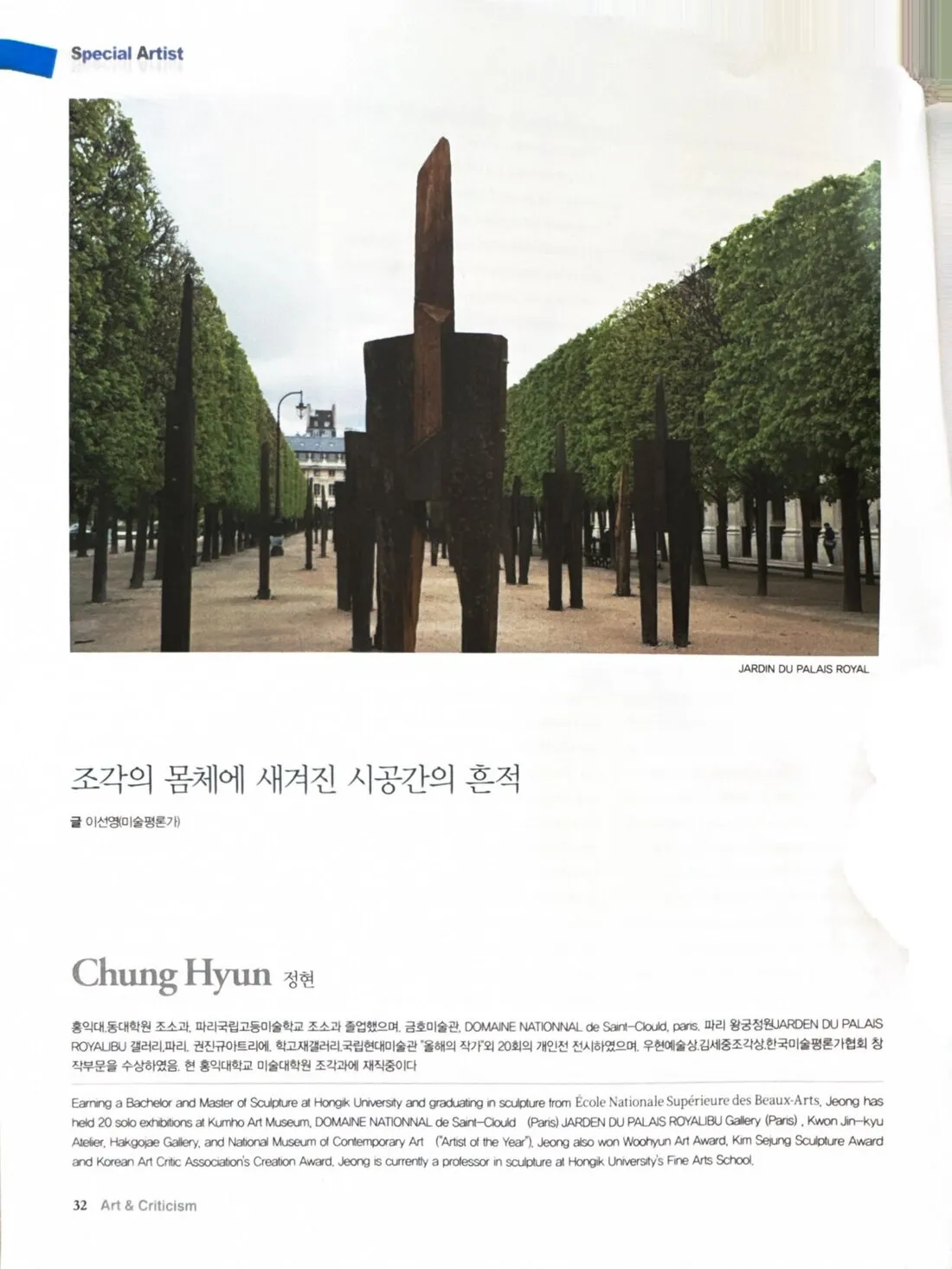
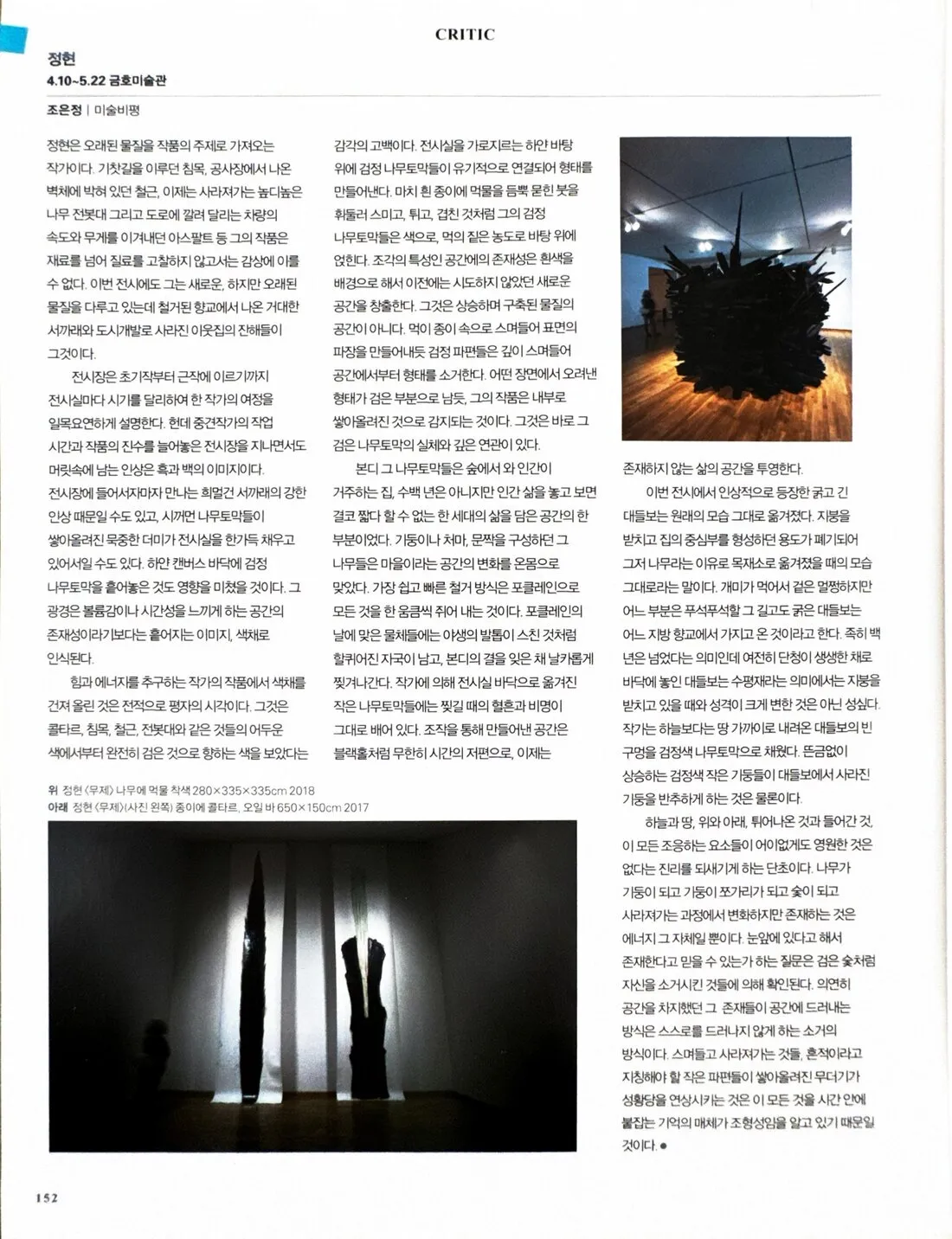
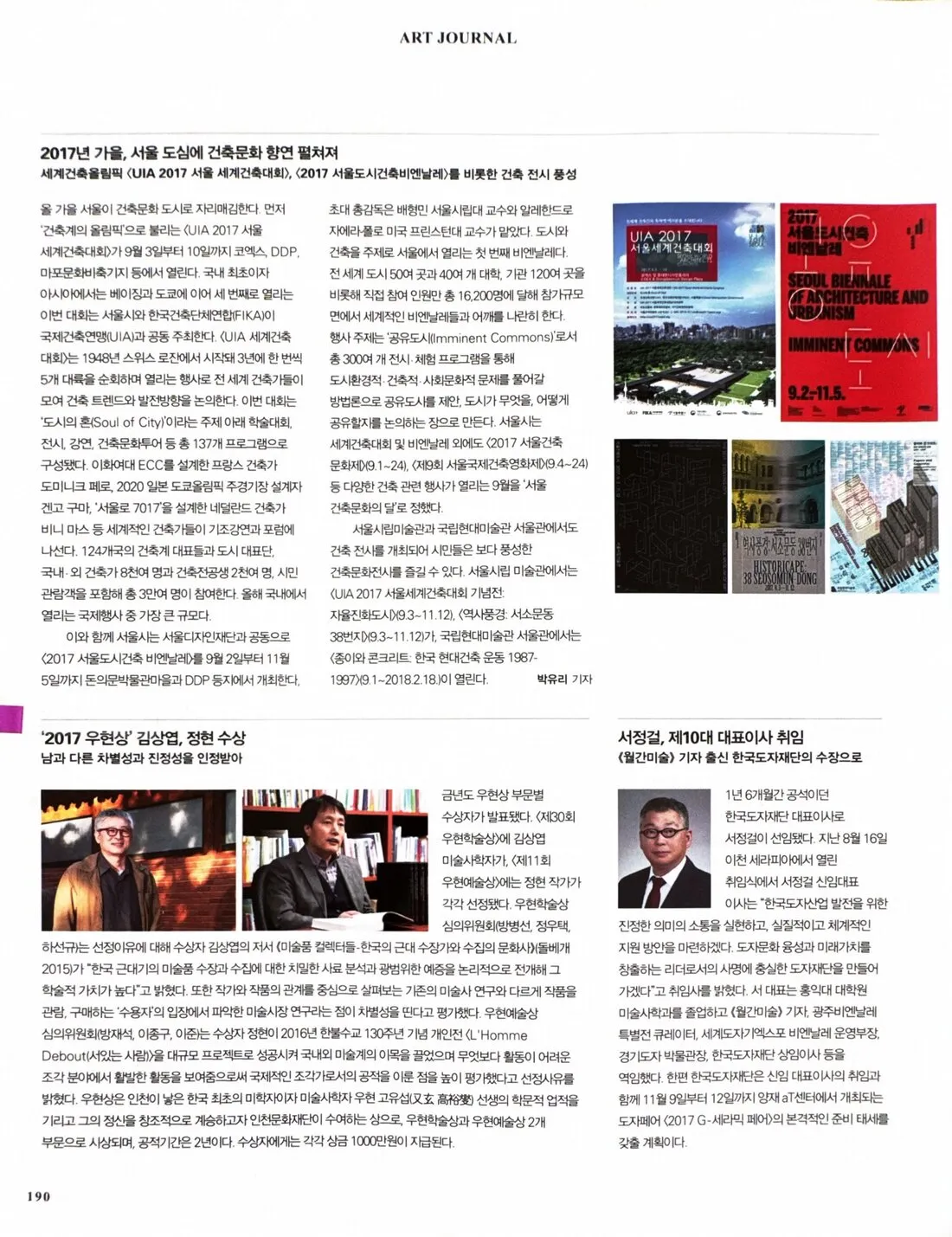
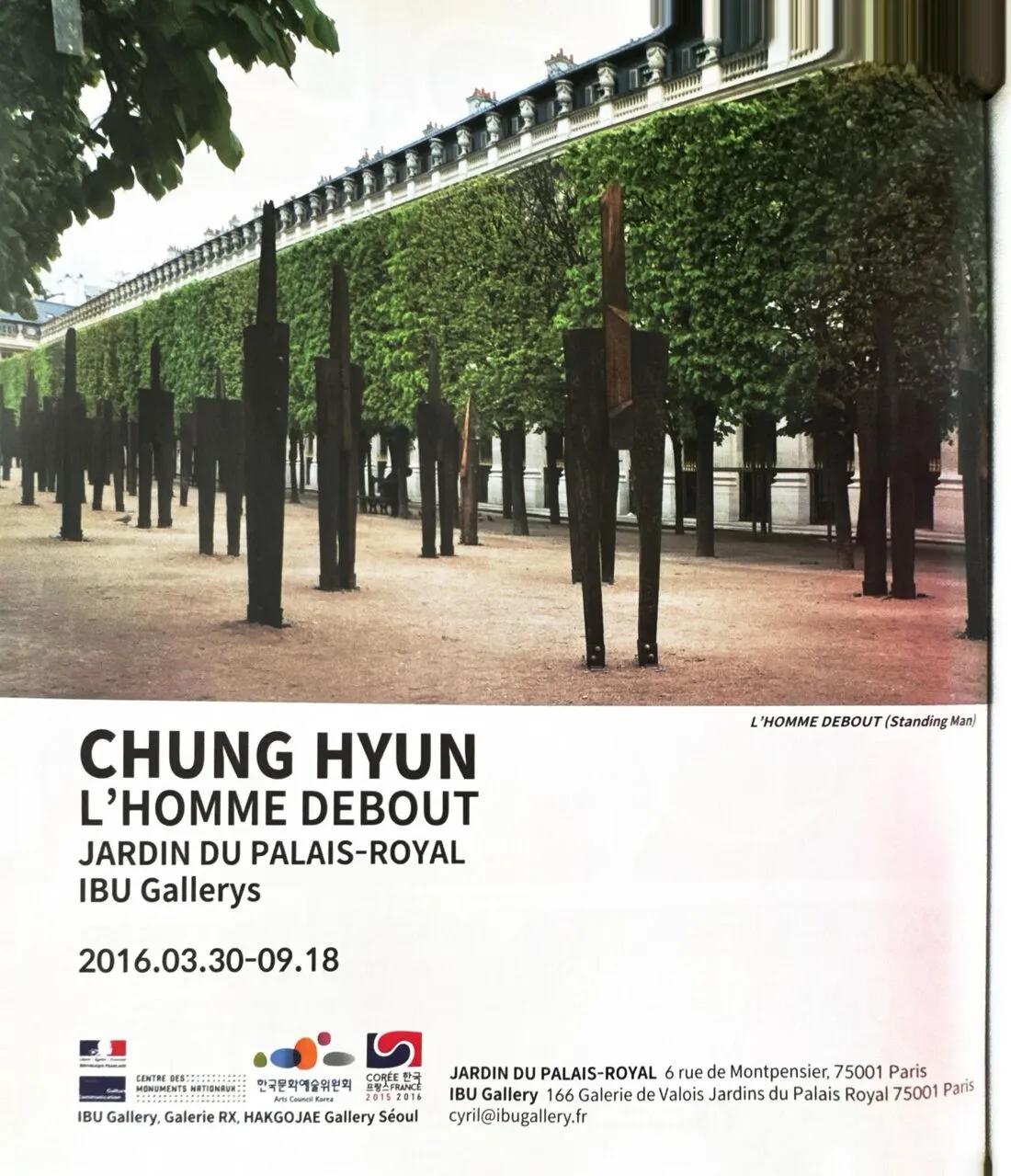
Selected Press
Press coverage in major Korean media, 2008–2025.
2025 1
- 더퍼블릭 안재영의 미술 프리즘_ 정현, 부산물(byproduct) 활용을 통해 불러들인 인문학적 소통 _ 칼럼 _ PEOPLE Ahn Jae-young’s Art Prism: Chung Hyun — Humanistic Dialogue Drawn from Byproducts
2024 19
- 뉴스핌 아트바젤 마이애미서 큰성과 거둔 조각가 정현,'김복진미술상'도 수상 Sculptor Chung Hyun, Acclaimed at Art Basel Miami, Also Wins the Kim Bok-jin Art Award 2024.12.28
- 동양일보 2회 김복진 미술상에 정현 작가 _ 문화 _ 기사본문 - 동양일보 Sculptor Chung Hyun Wins the 2nd Kim Bok-jin Art Award 2024.12.26
- 아시아투데이 큐레이터 김주원의 ‘요즘 미술’ 정현의 조각 시(彫刻 詩·Sculptural Poetry) Curator Kim Joo-won’s ‘Art Today’: Chung Hyun’s Sculptural Poetry 2024.12.15
- 서울문화투데이 아트 바젤 마이애미, ‘에디터 픽’에 한국 작가 작품 선정 Korean Artist Selected for Art Basel Miami ‘Editors’ Picks’ 2024.12.11
- 서울문화투데이 정현 조각가 “세상에 하찮은 것은 없다…빛나지 않는 것들에 주목” Sculptor Chung Hyun: ‘Nothing in the World Is Worthless — Attend to the Things That Don’t Shine’ 2024.12.03
- Art Basel Editors’ picks_ Seven unmissable projects at Art Basel Miami Beach _ Art Basel 2024.12.02
- Martin Cid Magazine Timeless Resonance_ Chung Hyun's Sculptural Poetry at Art Basel Miami Beach 2024 2024.11.18
- 뉴스핌 프리즈서울서 놓쳐선안될 작품12..정현·아니카이에서 피에르위그까지 12 Must-See Works at Frieze Seoul — From Chung Hyun and Anicka Yi to Pierre Huyghe 2024.09.07
- 뉴스프리존 정현과 고요손 작가가 보여주는 '서구 넘기' ‘Beyond the West,’ as Shown by Chung Hyun and Goyo Son 2024.08.24
- 서울문화투데이 이은주의 미술현장크리틱_정현의 조각 가상의 데이터 덩어리 Lee Eun-joo’s On-Site Critique: Chung Hyun’s Sculpture as a Mass of Virtual Data 2024.03.04
- 서울앤 섬 돌을 ‘3D 스캐닝 기법으로 확대·축소’…재료의 살아내고 견뎌온 시간 표현 _ 문화일반 _ 문화 _ 뉴스 _ 서울& Island Stones Scaled Up and Down by 3D Scanning: Expressing the Time a Material Has Lived and Endured 2024.02.15
- 한겨레 권진규·정현의 얼굴상, 추사의 세한도…설 연휴 전시도 풍성 Kwon Jin-kyu and Chung Hyun’s Faces, Chusa’s Sehando: A Rich Lunar New Year Exhibition Season 2024.02.08
- 한국경제 쓸모없다는 것들의 쓸모로 투박한 위로를 건네다 _ 한국경제 Rough Consolation from the Usefulness of the Useless 2024.02.05
- 국방일보 무쓸모의 쓸모에 대한 예술적 탐구 An Artistic Inquiry into the Use of the Useless 2024.01.30
- 뉴스원 예술로 승화한 침목, 폐자재, 고철…정현 개인전 '덩어리' Railroad Ties, Scrap and Waste Sublimated into Art: Chung Hyun’s Solo Exhibition ‘Mass’ 2024.01.22
- 동아일보 돌멩이… 고철… 버려진 재료에서 찾은 영감 Pebbles and Scrap Metal: Inspiration Found in Discarded Materials 2024.01.19
- 중앙일보 폐 침목, 석유 찌꺼기, 돌멩이…묵묵히 쓸모 다한 것들, 하찮다고 무시 말라 _ 중앙일보 Old Ties, Oil Residue, Stones — Don’t Dismiss the Spent and Humble 2024.01.16
- K스피릿 쓸모를 다한 재료로 작품을 만든다, 조각가 정현의 개인전《덩어리》 Making Art from Spent Materials: Sculptor Chung Hyun’s Solo Exhibition ‘Mass’ 2024.01.02
- 서울경제 조각가 정현-아티스트 고요손, '제일 뒤가 가장 앞이다' 전시 개최 _ 네이트 뉴스 Sculptor Chung Hyun and Artist Goyo Son Present ‘The Very Back Is the Very Front’
2023 13
- 문화뉴스 현대제철, 서울시립남서울미술관 정현 개인전 후원_최은서기자 Hyundai Steel Sponsors Chung Hyun’s Solo Exhibition at Nam-Seoul Museum of Art 2023.12.21
- 시사오늘 포스코, 14년 연속 글로벌 경쟁력 철강사 1위…현대제철, 남서울미술관 ‘정현 개인전’ 후원 [철강오늘] Hyundai Steel Backs the ‘Chung Hyun Solo Exhibition’ at Nam-Seoul Museum of Art 2023.12.21
- 파이낸셜투데이 ‘순환의 가치’ 알리는 현대제철, 정현 작가 개인展 후원한다 Hyundai Steel, Championing ‘the Value of Circulation,’ Sponsors Chung Hyun’s Solo Exhibition 2023.12.21
- 서울문화투데이 서울시립 남서울미술관, 정현 개인전 《덩어리》⋯쓸모를 다한 재료, 조각으로 재탄생 Nam-Seoul Museum of Art — Chung Hyun’s Solo ‘Mass’: Spent Materials Reborn as Sculpture 2023.12.20
- SayArt Sculptor Chung Hyun holds a solo exhibition, ′MASS′ 2023.12.20
- 뉴시스 발에 차이던 돌들의 '덩어리진 시간'…남서울미술관, 정현 개인전 The ‘Massed Time’ of Underfoot Stones: Chung Hyun’s Solo at Nam-Seoul Museum of Art 2023.12.19
- 뉴스프리존 둥글거나 뽀족한 '원시'를 구현하는 정현 작가 Chung Hyun, Embodying the Round and the Sharp ‘Primal’ 2023.12.19
- 경남신문 눈앞에 새긴 미래의 조각 Sculpture of the Future, Carved Before Our Eyes 2023.12.19
- 경남매일 창원조각비엔날레 프롤로그전 13일 열려 Changwon Sculpture Biennale Prologue Exhibition Opens on the 13th 2023.12.07
- 경북일보 포항시립미술관, POMA 찾아가는 미술관 ‘조각적 태도’ 전시 Pohang Museum of Steel Art’s Outreach Show ‘A Sculptural Attitude’ 2023.08.08
- 전남매일 돌에서 경험한 태고의 시간 Primordial Time, Experienced in Stone 2023.07.03
- 엘르 흔적으로 지은 덩어리_ 정현 개인전 #요즘전시 - LIFESTLYE A Mass Built from Traces: Chung Hyun’s Solo Exhibition
- Ocula Chung Hyun, 'Mass' at Seoul Museum of Art _ SeMA, Seoul, South Korea on 20 Dec 2023–17 Mar 2024
2022 15
- 뉴스핌 '대체불가'작가 정현,시련 겪은 대상에 깃든 '생명성'에 주목하다 ‘Irreplaceable’ Artist Chung Hyun Attends to the ‘Life’ Embedded in Weathered Things 2022.12.04
- 한겨레 인간 파헤친 역작들, 성북동 예술거리 수놓다 Masterworks Probing the Human, Adorning the Seongbuk-dong Art District 2022.11.30
- 문화일보 오후여담_‘침목의 조각가’ 정현 Afternoon Essay: Chung Hyun, ‘the Sculptor of Railroad Ties’ 2022.11.29
- 서울앤 상처받은 숯덩이와 침목에 ‘인간의 본질’을 새기다 _ 문화일반 _ 문화 _ 뉴스 _ 서울& Carving ‘the Essence of the Human’ into Scarred Charcoal and Railroad Ties 2022.11.17
- 한겨레 휴머니즘으로 현실 직시한 원로작가 4명 작품 한자리에 모였다 Four Senior Artists Confronting Reality through Humanism, Gathered in One Place 2022.11.16
- 조선일보 헐벗고 불타버려도… 나무는 건재하다 Stripped Bare and Burned, the Tree Still Stands 2022.11.08
- 국민일보 산업적 재료가 가지는, 있는 그대로의 쓰임새가 바로 작품 The Raw, As-Is Function of Industrial Materials Becomes the Artwork 2022.11.06
- 동아일보 허름-어눌한 듯한 조각속에 철학을 심다 Planting Philosophy in Rough, Unpolished Sculpture 2022.11.02
- 뉴스핌 다섯작가가 보여주는 드로잉의 매력, 그 생생한 세계 속으로 The Allure of Drawing by Five Artists: Into Its Vivid World 2022.11.02
- 서울경제 짓밟고 불태워도... 다시 일어선 인간의 자화상 Trampled and Burned, Yet Standing Again: A Self-Portrait of Humanity 2022.10.23
- 아시아경제 정현이 30년 천착한 인간 정신성과 조각 본질 The Human Spirit and the Essence of Sculpture: Chung Hyun’s 30-Year Pursuit 2022.10.09
- KBS ‘인간’과 ‘조각’의 본질을 탐구하다…성북구립미술관 정현 개인전 _ KBS 뉴스 Exploring the Essence of ‘the Human’ and ‘Sculpture’: Chung Hyun’s Solo at Seongbuk Museum of Art 2022.10.07
- 일요시사 아트&아트인 드로잉 개인전 정현 Chung Hyun — Drawing Solo Exhibition 2022.09.07
- 브레이크뉴스 여수 예울마루, 장도 창작스튜디오 3기 입주 Yeosu Yeulmaru: Third Cohort Moves into the Jangdo Creative Studio 2022.03.16
- 월간조선 2211 전시_긴 호흡, 다섯 작가의 드로잉-곽남신, 서용선, 오원배, 윤동천, 정현 드로잉전(展) A Long Breath: Drawings by Five Artists — Kwak Nam-sin, Suh Yong-sun, Oh Won-bae, Yoon Dong-chun, Chung Hyun 2022.11
2021 7
- 세계일보 인고의 시간 거친 인간 내면과 궤적 ‘조형 언어’로 표현하다 [김한들의 그림 아로새기기] Expressing the Inner Life and Trajectory of Endurance in a ‘Formal Language’ [Kim Han-deul’s Art Engravings] 2021.10.09
- 브릿지경제 경기문화재단, 2021 Let’s DMZ 평화예술제 ‘DMZ아트프로젝트-다시, 평화’ 보고전 개막 Gyeonggi Cultural Foundation Opens ‘DMZ Art Project — Again, Peace’ at the 2021 Let’s DMZ Peace Art Festival 2021.10.05
- 대한경제 설치ㆍ조각ㆍ퍼포먼스ㆍ그림…‘세종의 마음’ 풀어내다 Installation, Sculpture, Performance, Painting: Unfolding ‘the Heart of Sejong’ 2021.09.01
- 서울신문 임진각 평화누리 공원에 펼쳐친 ‘그날을 향한 염원’ ‘A Yearning Toward That Day,’ Unfolded at Imjingak Peace-Nuri Park 2021.05.24
- 중부일보 평화누리에서 통일을 외치다… 경기도미술관 'DMZ 아트프로젝트- 다시, 평화'展 진행 Calling for Reunification at Peace-Nuri: Gyeonggi Museum of Modern Art’s ‘DMZ Art Project — Again, Peace’ 2021.05.17
- 동아일보 “문학은 싸구려 힐링이 아니다”… 미술작품으로 읽는 김훈 ‘Literature Is Not Cheap Healing’: Reading Kim Hoon through Artworks 2021.02.17
- 헤럴드경제 소설가 김훈 주제 미술전…‘여기에서 나는 산다’ 展 An Art Exhibition on Novelist Kim Hoon: ‘Here, I Live’ 2021.01.28
2020 3
- 매일경제 서울 서소문 여행-서소문 밖 네거리의 새로운 문화 지도 A Trip to Seosomun, Seoul: A New Cultural Map of the Seosomun Crossroads 2020.03.19
- 헤럴드경제 죽음에 대한 자각, 삶을 위로하다 Awareness of Death, Consolation for Life 2020.03.02
- 이데일리 '시커멓게 불탄 나무'에서도 희망 봐야 하는 이유 Why We Should See Hope Even in ‘Blackened, Burned Wood’ 2020.02.24
2019 3
- 중부매일 J 갤러리_정현 作 '무제' J Gallery: ‘Untitled’ by Chung Hyun 2019.09.05
- 가톨릭신문 서소문성지역사박물관 개관 특별 기획전 ‘한국 현대조각의 단면’ Seosomun Shrine History Museum Opening Special Exhibition: ‘A Cross-Section of Korean Contemporary Sculpture’ 2019.06.11
- CNB저널 롯데갤러리-고려대박물관, 인천터미널점 개관전 기획 Lotte Gallery and Korea University Museum Plan the Incheon Terminal Branch Opening Exhibition 2019.01.09
2018 19
- 대경일보 예술작품으로 영일대를 물들인 ‘2018 포항스틸아트페스티벌’ 성료 ‘2018 Pohang Steel Art Festival,’ Coloring Yeongildae with Art, Comes to a Successful Close 2018.10.15
- 경향신문 포항 영일만 해변은 지금 ‘스틸아트 천국’ Pohang’s Yeongil Bay Beach Is Now a ‘Steel Art Paradise’ 2018.10.02
- 제민일보 눈 앞의 것들에서 진실을 찾아라 Find the Truth in the Things Before Your Eyes 2018.06.12
- imbc '문화사색' 철학자 강신주의 현대인의 인정 투쟁과 뒷이야기 공개! ‘Munhwa Sasaek’: Philosopher Kang Shin-joo on Modern People’s Struggle for Recognition 2018.05.25
- 뉴스핌 견뎌낸다는 것, 다시 선다는 것…정현의 조각세계 To Endure, to Stand Again: The Sculptural World of Chung Hyun 2018.05.14
- 세계일보 “혹독한 시련을 견딘 폐침목·대들보… 그 스스로 많은 이야기를 품고 있죠” ‘Old Ties and Beams That Endured Harsh Trials Hold Many Stories of Their Own’ 2018.04.17
- 국방일보 '꿈틀' 세월 견뎌낸 기찻길의 환골탈태 A Stirring Rebirth: Railway Tracks That Withstood the Years 2018.04.15
- 매일경제 300년 한옥의 대들보·철로 폐목…예술이 되다 A 300-Year-Old Hanok Beam and Discarded Railway Wood Become Art 2018.04.13
- 뉴스1 수명 다한 대들보 수백년 세월 돌아 미술관에 오다 A Spent Beam Arrives at the Museum After Centuries 2018.04.12
- 아트인포 조각가 정현, 버려진 재료로 현대 사회를 이겨내며 살아가 Sculptor Chung Hyun: Persevering Through Modern Society with Discarded Materials 2018.04.12
- 이코노미톡뉴스 정현, 폐목재로 현대 사회를 이겨내며 살아가고 있는 인간의 삶 표현 Chung Hyun Depicts Human Life Persevering Through Modern Society, in Discarded Wood 2018.04.12
- 연합뉴스TV 버려진 침목ㆍ글자의 재해석…이달의 전시 Discarded Ties and the Reinterpretation of Letters: This Month’s Exhibitions 2018.04.11
- 뉴시스 테니스 정현 말고 조각가 정현...금호미술관 개인전 Not the Tennis Player — Sculptor Chung Hyun’s Solo at Kumho Museum of Art 2018.04.10
- 연합뉴스 조각가 정현 _시련이 잘 들러붙은 폐침목서 숭고함 느껴 Sculptor Chung Hyun: ‘I Feel the Sublime in Old Ties Steeped in Hardship’ 2018.04.10
- 서울경제 누가 이들을 쓸모없다 했는가 Who Said These Were Useless? 2018.04.10
- 파이낸스투데이 조각가 정현 폐기된 대들보를 목공소에서 우연히 발견 조각품으로 소생 Sculptor Chung Hyun Revives a Discarded Beam, Found by Chance at a Carpentry Shop, as Sculpture 2018.04.10
- 헤럴드경제 “찢겨지고 부러진 나무…곤란한 삶의 모습같지 않나” ‘Torn and Broken Wood — Doesn’t It Resemble a Hard Life?’ 2018.04.10
- 서울신문 쓸모 다해 버려진 잔해들, 인간의 삶 되새기다 Spent, Discarded Remains Reflect on Human Life 2018.04.10
- 한겨레 1804 버려진 대들보가 내뿜는 시간의 힘 The Power of Time Radiating from a Discarded Beam
2017 3
- 서울신문 나무와 마주한 조각가...‘전후 한국 현대 목조각의 흐름’전 A Sculptor Facing Wood: ‘Currents of Postwar Korean Contemporary Wood Sculpture’ 2017.10.12
- 뉴시스 '우현학술상' 김상엽 미술사학자, '우현예술상' 정현 조각가 Art Historian Kim Sang-yeop Wins the Wuhyon Academic Prize; Sculptor Chung Hyun, the Wuhyon Art Prize 2017.08.23
- 서울경제 조각가 정현, 우현예술상 수상 Sculptor Chung Hyun Wins the Wuhyon Art Prize 2017.08.23
2016 7
- Artsy Chung, Hyun's Solo Exhibition 2016.10.14
- 뉴스1 프랑스의 6월 초, 한국 문화로 물든다 - Early June in France, Awash in Korean Culture 2016.05.26
- 서울경제 한불수교 130년…정현·바비에 양국 수도서 전시 130 Years of Korea–France Relations: Chung Hyun and Barbier Exhibit in Both Capitals 2016.04.17
- 뉴시스 조각가 정현, 서있는 사람 50점... 파리 팔레루아얄궁에 전시 Sculptor Chung Hyun Shows 50 ‘Standing Man’ Works at the Jardin du Palais-Royal, Paris 2016.03.29
- 연합뉴스 조각가 정현, 파리 팔레 루아얄 정원서 개인전 Sculptor Chung Hyun’s Solo Exhibition at the Jardin du Palais-Royal, Paris 2016.03.29
- 스포츠서울 佛 파리 팔레루아얄정원에서 조각가 정현 ‘서있는 사람’전 개최 Sculptor Chung Hyun’s ‘The Standing Man’ Opens at the Jardin du Palais-Royal, Paris 2016.03.29
- 아주경제 헝가리에서 만나는 한국 현대미술 Korean Contemporary Art, Encountered in Hungary 2016.02.12
2015 9
- 기호일보 仁川 김병종·김경인·정현 예술가 _ Incheon Artists: Kim Byung-jong, Kim Kyung-in, Chung Hyun 2015.11.24
- 시민일보 인천시, 미술 분야 인천인 작가 초대전 개최 Incheon City Holds an Invitational Exhibition of Incheon-Born Artists 2015.11.23
- 일요신문 종로구, 10월 22일부터 3개월간 ‘춘곡 고희동 50주기 특별전’ 개최 Jongno-gu Holds a Three-Month Special Exhibition Marking the 50th Anniversary of Chungok Go Hui-dong 2015.10.22
- 아시아경제 최초 서양화가 춘곡 고희동 50주기 특별전 A Special Exhibition Marking the 50th Anniversary of Go Hui-dong, Korea’s First Western-Style Painter 2015.10.21
- 연합뉴스 권진규 아틀리에 첫 번째 기획전…정현展 The First Special Exhibition at the Kwon Jin-kyu Atelier: Chung Hyun 2015.10.19
- 한국경제 예술의 옷 입은 송도…아트시티 프로젝트 공개 Songdo Dressed in Art: The Art City Project Unveiled 2015.09.08
- 헤럴드경제 한-불 상호교류의 해 한ㆍ프랑스 문화예술 현주소를 ‘발견’하다 ‘Discovering’ the State of Korean and French Arts in the Year of Korea–France Exchange 2015.05.30
- 이데일리 포스코미술관, 개관20주년 기념 '철이 철철'展 POSCO Art Museum’s 20th-Anniversary Exhibition ‘Iron Overflowing’ 2015.05.27
- CNB저널 [아트인 선정 전시]LIG 아트스페이스 ‘힐링 모자이크’전 LIG Art Space’s ‘Healing Mosaic’ Exhibition 2015.04.22
2014 19
- 매일경제 힐링 콘서트 최고의 맛, 최고의 조각 Healing Concert: The Finest Taste, the Finest Sculpture 2014.11.03
- CNB 저널 이 사람 - 정현 작가_“시련은 아름답다” This Person — Artist Chung Hyun: ‘Hardship Is Beautiful’ 2014.10.30
- 경향신문 상처난 쇳덩어리에 불어넣은 생명… 조각가 정현 ‘정현’전 Life Breathed into Scarred Iron: Sculptor Chung Hyun’s ‘Chung Hyun’ Exhibition 2014.10.27
- 동아일보 고미석의 詩로 여는 주말 가을 Ko Mi-seok’s Weekend Opened with a Poem: Autumn 2014.10.25
- 이데일리 닳아빠진 쇳덩이·녹내린 캔버스, 예술되다 Worn Iron and Rust-Stained Canvas Become Art 2014.10.24
- 서울경제 정현조각가, 홍익대교수 Sculptor Chung Hyun, Professor at Hongik University 2014.10.24
- 서울신문 인고의 세월을 견뎌온 쇳덩어리 Lumps of Iron That Endured Years of Hardship 2014.10.21
- 문화일보 鐵의 노래… 녹물로 새긴 세월 Song of Iron: Years Inscribed in Rust 2014.10.21
- 헤럴드경제 “녹물로 새긴예술 감상하세요”조각가 정현 개인전 ‘Come See Art Inscribed in Rust’: Sculptor Chung Hyun’s Solo Exhibition 2014.10.20
- 매일경제 조각가 정현 _제대로 된 시련은 오히려 아름답죠 Sculptor Chung Hyun: ‘True Hardship Is, in Fact, Beautiful’ 2014.10.17
- 머니투데이 16톤에서 8톤으로…재료를 깨뜨리고 뭉갠 상처의 조각들 From 16 Tons to 8: Sculptures of Wounds, Their Material Broken and Crushed 2014.10.17
- 한국경제 쇳덩이 부수고 깨는 파쇄공…격정적인 현대사와 닮았죠 A Crusher Smashing and Breaking Iron: ‘It Resembles Our Turbulent Modern History’ 2014.10.16
- 연합뉴스 시련을 잘 겪은 뒤의 것들은 언제나 아름답다 Things That Have Weathered Hardship Well Are Always Beautiful 2014.10.14
- 연합뉴스 조각가 정현 _잘 겪은 시련은 아름답다_ Sculptor Chung Hyun: ‘Hardship Well Endured Is Beautiful’ 2014.10.14
- CNB 저널 정현 작가 '삶의 모든 시련을 작품 속에 담았다' Artist Chung Hyun: ‘I Have Held All of Life’s Trials in My Work’ 2014.10.14
- CNB뉴스 정현 작가 삶의 모든 시련을 작품 속에 담았다 Artist Chung Hyun Holds All of Life’s Trials in His Work 2014.10.14
- 연합뉴스 제28회 김세중조각상에 정현 Chung Hyun Wins the 28th Kim Sechoong Sculpture Prize 2014.06.20
- CNB 뉴스 조각가 정현, 2014년 제28회 김세중조각상 본상 수상자 선정 Sculptor Chung Hyun Named Grand Prize Winner of the 28th Kim Sechoong Sculpture Prize (2014) 2014.06.17
- CNB뉴스 조각가 정현, 2014년 제28회 김세중조각상 본상 수상자 선정 Sculptor Chung Hyun Selected as 2014 Grand Prize Winner of the 28th Kim Sechoong Sculpture Prize 2014.06.17
2013 5
- 헤럴드경제 ‘파워와 아름다움’은 어디서 오는가_ 소마미술관 ‘Power & Beauty’전 Where Do ‘Power and Beauty’ Come From? SOMA Museum’s ‘Power & Beauty’ 2013.07.23
- 서울경제 힘은 아름다움과 선함의 조화 Power: A Harmony of Beauty and Goodness 2013.07.14
- 스포츠월드 올림픽 25주년 기념 소마미술관 ‘힘, 아름다움은 어디에 있는가’전 SOMA Museum’s Olympic 25th-Anniversary Show ‘Power: Where Is Beauty?’ 2013.07.04
- 인천일보 지역미술 '발전·화합' 밑거름 되다 _ Becoming the Bedrock of Local Art’s ‘Growth and Harmony’ 2013.07.02
- 경인일보 선광미술관 개관 기념 지역 작가 33인 '인천愛전' Sunkwang Museum Opening: 33 Local Artists in the ‘Love for Incheon’ Exhibition 2013.06.23
2011 12
- 아주경제 국립현대미술관 '올해의 작가'전 23명 누굴까 Who Are the 23 in MMCA’s ‘Artist of the Year’ Exhibition? 2011.08.12
- 경향신문 국립현대미술관 ‘올해의 작가’ 23인 한자리 MMCA’s 23 ‘Artists of the Year’ Together in One Place 2011.08.11
- 경향신문 공부하는 예술가의 진중한 시선 The Earnest Gaze of an Artist Who Studies 2011.08.11
- 천지일보 15년 되짚는 ‘올해의 작가 23인展’ 미술후원제 확립 ‘23 Artists of the Year,’ Tracing 15 Years and Establishing an Art Patronage System 2011.08.09
- 아주경제 예술가들의 내면세계 탐구, 사비나미술관 'STUDY'展 Exploring Artists’ Inner Worlds: Savina Museum’s ‘STUDY’ 2011.07.27
- 동아일보 작품으로 확장된 드로잉의 깊은 맛 The Deep Flavor of Drawing, Expanded into Artworks 2011.07.12
- 경향신문 긋는다 존재의 시작, 한 획… 담는다 내 삶을, 정신을 To Draw a Line, the Beginning of Being; to Hold My Life and Spirit 2011.07.07
- 서울경제 예술가의 창의성 담은 '한 획' ‘A Single Stroke’ Holding an Artist’s Creativity 2011.07.05
- 문화일보 드로잉, 작가의 사색 담긴 내밀한 일기 Drawing: An Intimate Diary of the Artist’s Contemplation 2011.06.09
- 서울경제 '실험작가의 산실' 21년 발자취 한눈에… ‘Cradle of Experimental Artists’: 21 Years of Footsteps at a Glance 2011.01.11
- 연합뉴스 평론가 23명, 작가 49명을 평하다 23 Critics Assess 49 Artists 2011.01.04
- 한겨레 선, 혼을 담다 The Line, Holding the Soul
2010 18
- 매일경제 `한국 실험작가 산실` 금호미술관 개관 21주년 Kumho Museum of Art, ‘Cradle of Korean Experimental Artists,’ Marks Its 21st Anniversary 2010.12.12
- 연합뉴스 21년간 금호미술관을 거쳐간 작가들 The Artists Who Passed Through Kumho Museum of Art over 21 Years 2010.12.10
- 뉴시스 제일 잘나가는 조각가 65명 작품 한데 모았다 Works by 65 of the Most Sought-After Sculptors, Gathered Together 2010.12.09
- 연합뉴스 문화소식_ 갤러리SP, 조병왕전 Arts Briefs: Gallery SP, Jo Byung-wang Exhibition 2010.11.22
- YTN 한국 미술의 뿌리를 찾아서 In Search of the Roots of Korean Art 2010.09.28
- 서울경제 현대미술과 古미술 다른 듯 닮은 매력 Contemporary and Old Art: A Charm Different Yet Alike 2010.08.31
- 문화일보 고미술-현대미술 시공 초월한 ‘교감’ Old and Contemporary Art: A ‘Communion’ Beyond Time and Space 2010.08.31
- 한국경제 알록달록 현대미술, 겸재·추사에 말을 걸다 Colorful Contemporary Art Strikes Up a Conversation with Gyeomjae and Chusa 2010.08.29
- 연합뉴스 한국 현대미술, 어디서 왔을까 Where Did Korean Contemporary Art Come From? 2010.08.27
- 연합뉴스 현대미술, 강진에 '조용히 스며들다' Contemporary Art ‘Quietly Seeps into’ Gangjin 2010.08.08
- 매경이코노미 ‘제2회 매경이코노미 명품 CEO 소장품 전시회’ 오프닝 이모저모 Scenes from the Opening of the 2nd Maekyung Economy Luxury CEO Collection Exhibition 2010.08.04
- 연합뉴스 강진 청자축제와 함께 현대미술 감상하세요 Enjoy Contemporary Art Alongside the Gangjin Celadon Festival 2010.08.03
- 매경이코노미 ‘제2회 CEO 소장품 전시회’ 엿보기 A Glimpse of the 2nd CEO Collection Exhibition 2010.07.28
- 연합뉴스 미술교과서 속 작가 48명 한자리에 48 Artists from Art Textbooks, Together in One Place 2010.07.17
- 서울경제 절망·희망 공존하는 '깊은 울림' A ‘Deep Resonance’ Where Despair and Hope Coexist 2010.06.20
- 뉴시스 현대미술 30년 에센스 '젊은모색' 17일 개막 The Essence of 30 Years of Contemporary Art: ‘Young Korean Artists’ Opens on the 17th 2010.04.16
- 연합뉴스 국립현대미술관 '젊은모색' 30주년 기념전 MMCA’s 30th-Anniversary Exhibition of ‘Young Korean Artists’ 2010.04.07
- 매경이코노미 1007Who`s CEO_이용익 신흥 사장 Who’s CEO: Lee Yong-ik, President of Shinheung
2009 5
- 한겨레 금속으로 두드린 누천년 역사 Millennia of History, Hammered in Metal 2009.06.02
- 문화일보 도쿄서… 베이징서… 중진작가 잇단 해외展 In Tokyo, in Beijing: Mid-Career Artists’ Successive Overseas Exhibitions 2009.02.18
- 서울경제 조각가정현, 中금일미술관서 개인전 Sculptor Chung Hyun’s Solo Exhibition at Today Art Museum, China 2009.02.09
- 연합뉴스 중화권서 열리는 한국 작가전 2題 Two Korean Artist Exhibitions Opening in Greater China 2009.02.09
- 한국경제 화가들 해외시장 개척 고삐 죈다 Artists Tighten Their Push into Overseas Markets 2009.02.01
2008 2
- 매일경제 이영배ㆍ정현 동갑내기 작품전 Lee Young-bae and Chung Hyun: An Exhibition by Two Artists of the Same Age 2008.09.10
- 연합뉴스 학고재 이배전 정현전 동시 개막 Hakgojae Opens Lee Bae and Chung Hyun Exhibitions Simultaneously 2008.09.02